
Poor quality of education is one of the most important reasons for high unemployment in India, says Kavita Nigam.

The Economic Survey called for improving business environment.

Several individuals and organisations, including the US Chambers of Commerce and the National Association of Manufacturers, have filed a lawsuit against the Trump administration's recent rules related to the H-1B visa, terming them "arbitrary" and "haphazard" regulations that will undermine high skilled immigration into America. Early this month, the Trump administration announced new restrictions on H-1B non-immigrant visa programme which it said is aimed at protecting American workers, restoring integrity and to better guarantee that H-1B petitions are approved only for qualified beneficiaries and petitioners, a move which is likely to affect thousands of Indian IT professionals.
According to the IHS Markit India Business Outlook, predictions of softer activity growth underpin the downward revisions of profit outlook, subdued hiring plans and relatively muted capital expenditure.
Buoyed by an increase in public investment and incentives to boost manufacturing, India's economy is expected to grow by 8.3 per cent in the fiscal year 2021-22, less than the previous projection early this year before the country was hit by the second wave of the COVID-19 pandemic, the World Bank has said in its latest report. World Bank chief economist for the South Asia Region Hans Timmer told PTI here that when one looks at the high frequency data, they see that as a result of the second wave of the COVID-19 pandemic, the recovery paused, and some indicate that the recovery actually declined briefly. "We project for this fiscal year 8.3 per cent (growth rate for Indian economy) that is less than we projected early in the year before the health crisis caused by the second wave. "Given the sharp contraction of the economy last year, it might not look like a lot, but in my view, that is actually very positive news, given the violent second wave and the severity of the health crisis," he said on Thursday.

Interview with Professor, Stanford University.
NITI Aayog wants the prime minister's flagship initiative should focus on labour-intensive sectors and policies that impede their growth to get special attention.
Hailing Prime Minister Narendra Modi's Make in India campaign and the emphasis on ease of doing business, India Inc today said the initiative mirrors the country's ambition to sprint ahead in the global manufacturing race, thereby creating jobs and boosting economic growth.

The Economic Survey was tabled in the Parliament on Friday.

With economic growth slowing to a six-year low, IMF Chief Economist Gita Gopinath says the government should undertake structural reforms such as bank clean-up and labour reforms to address the slowdown in domestic demand. She rooted for government policies focusing on managing a slowdown in domestic demand, and on boosting productivity growth and supporting employment creation in the medium term.

'The new government will have to contend with slowing economic growth, weak private investment, anaemic exports and vulnerable external imbalances, a stressed financial system, mounting fiscal pressures (including high government debt-to-GDP ratios) and an exceptionally bad employment situation,' says Shankar Acharya, former chief economic adviser to the Government of India.

What we want from spectrum allocation is access to broadband networks at prices that will result in productivity gains.

Prime Minister Narendra Modi on Saturday hard sold his government's reforms spanning from manufacturing to taxation to labour, saying they have changed the world perception about the country from 'why India' to 'why not India' and went on to quote record foreign investment during the pandemic as a testimony to that. Speaking at industry association Assocham's Foundation Week event, Modi also said agriculture reforms brought by his government six months back have started benefiting farmers. The reforms in the last six years have influenced in changing the sentiment of the industry from 'why India' to 'why not India' in investing.

Nearly 490 million people of working age are outside the bounds of India's unemployment assessments. A decrease in the unemployment rate could signal economic growth, but could just as well mean that people have given up looking for work. A revealing excerpt from Tata Sons Chairman N Chandrasekaran and Tata Chief Economist Roopa Purushothaman's Bridgital Nation: Solving Technology's People Problem.


'The current crisis is one of incomes, driven by poor job growth, agrarian distress and poor investment sentiment,' notes Harsh Pati Singhania, director, JK Organisation.

Prime Minister Narendra Modi on Thursday launched the ambitious 'Make in India' campaign to make India a global manufacturing hub, create jobs and boost economic growth.

Gujarat has topped with a score of 71.14% on ease of doing business list.

The number of Internet users has more than tripled in a decade.
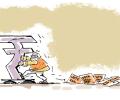
'We have promised to ensure reduced tax rates.'

Finance Minister Arun Jaitley hints at a world class tax regime.

'The Indian State needs to focus on healthcare, education, infrastructure and law and order, and get out of all these regulatory cholesterols.' 'Then, India will fly.'
'We can only hope that the government has finally 'got it' and will stay focused on improving productivity, demand, and governance,' says Debashis Basu.

'Rather than cutting and pasting from advanced economies, we should use basic economic principles to think about what is right for India at the stage of development at which we are,' says Chief Economic Advisor Krishnamurthy Subramanian.

Instead of targeting global imbalances per se, the narrative must change to the structure and direction of such asymmetries.

Mr Prabhu has a big challenge ahead in implementing trade reforms to regain the lost export momentum, says Jayanta Roy.

'If the government had not spent an incredible amount of energy on demonetisation it may -- may, because it had not done anything the previous six months either -- have been able to pay attention to the deeper problems of low investment and job creation.'
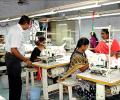
With China and Bangladesh losing their edge, textile exports from Tirupur are rising once again, turning the city into a job magnet.

Here's the full text of President's Ram Nath Kovind's address to the joint sitting of both houses of Parliament on the first of Budget Session 2022.

Any investment proposal in India has to be cleared by the Cabinet which leads to a vicious cycle of approvals and rejections, says

The 'Make in India' vision cannot survive in the long-term without concrete measures to build a concurrent 'Create in India' movement.

Over 15 years, with seven per cent growth, the Indian economy will be three times bigger.

India has more than 45 million SMEs, accounting for nearly 40 percent of gross domestic product.

Finance Minister P Chidambaram, while addressing the Carnegie Endowment for International Peace on "Recapturing India's Growth Momentum" in Washington on Thursday, said that the leading think tank need not launch an initiative to explore how India will vote in 2014, declaring that the Indian polity will vote the Congress back into power.

Here's the full text of President Ram Nath Kovind's customary address to the joining sitting of Parliament on the first day of the budget session.

Indian govt is trying hard to get global investors to invest in the country.

The failure to reform has meant that there is no buzz about job opportunities, or about urban opportunities enticing young people off the farms. And it is this failure that has contributed to the widespread disappointment that threatens to make the next general elections closer than expected, says Mihir S Sharma.
'The much-awaited decision could be a welcome change at a time when the Indian armed forces are crying for self-reliance and the defence industry is looking forward to more indigenisation,' notes Nitin A Gokhale.
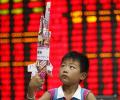
Markets will continue to remain volatile till the Chinese economy shows some signs of stability

The euphoria of Ab Ki Baar Modi Sarkar will fade quickly if the Modi government does not raise its game, and focus significant monetary resources and managerial skills on making India's infrastructure truly world-class, says Ram Kelkar.
 © 2026 Rediff.com - Advertise with us - Disclaimer - Privacy Policy - Sitemap - Feedback - About us - Terms of use - Grievances